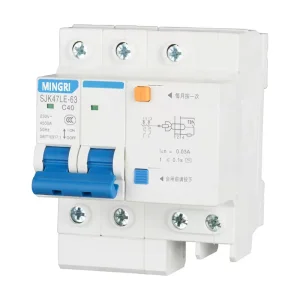
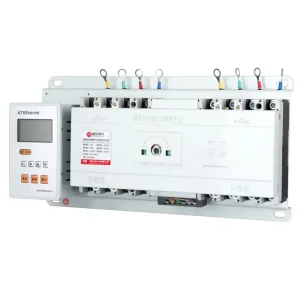
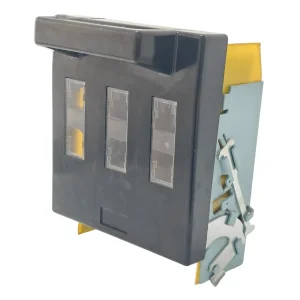
Primary Low-Voltage & Power Control Apparatus
Engineered alongside our flagship contactor line, these primary switching, disconnect, and protection devices form a robust ecosystem designed to meet stringent industrial power handling demands.
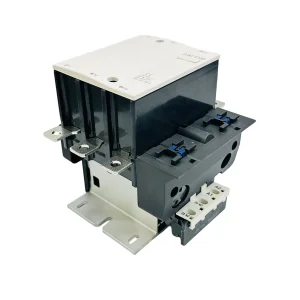
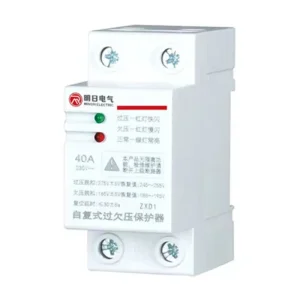
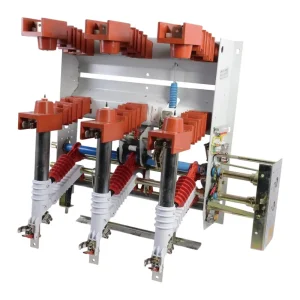
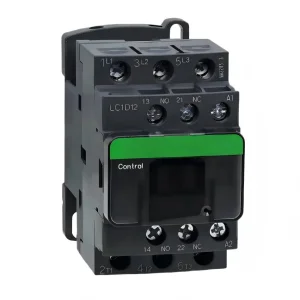
LC1D Contactor Series: Industrial Switching Architecture
The LC1D (globally cross-referenced with CJX2 platforms) represents the industrial benchmark in low-voltage AC motor switching and non-inductive load control. Designed with modularity, high arc quenching speed, and high thermal stability, these contactors ensure operational safety across heavy-duty environments.
Optimized Arc Chamber Dynamics
Engineered with high-permeability de-ionizing steel splitter plates, our arc chute splits and extinguishes high-temperature electrical arcs in under 12 milliseconds. This limits contact erosion during severe AC-3 and AC-4 switching routines, extending equipment life under repetitive jogging.
Advanced Metallurgy Contacts
We utilize proprietary silver-nickel (AgNi) for lower ratings and silver-tin-indium oxide (AgSnO2In2O3) for high-amperage switching. These compositions prevent welding during locked-rotor starting current spikes (reaching 6x to 8.5x nominal amperage) and resist surface oxidation.
Fail-Safe Auxiliary Topologies
Mechanically linked contact mechanisms compliant with IEC 60947-5-1 Annex L and mirror contacts (IEC 60947-4-1 Annex F) prevent concurrent closure of normally open (NO) and normally closed (NC) circuits, safeguarding functional safety loops in automated systems.
Engineering Matrix: LC1D / CJX2 Selection Parameters
Understanding the precise technical parameters ensures optimal thermal and electrical sizing. Review our core technical baseline across standard industrial ratings below:
| Model Designation | Rated Operational Current (Ie) AC-3 (400V) | Standard Motor Power Rating (P) 400V | Thermal Current (Ith) AC-1 | Built-in Auxiliary Contacts | Recommended Backup Short-Circuit Protection (aM) |
|---|---|---|---|---|---|
| LC1D09 / CJX2-09 | 9 A | 4.0 kW | 25 A | 1 NO + 1 NC | 20 A |
| LC1D12 / CJX2-12 | 12 A | 5.5 kW | 25 A | 1 NO + 1 NC | 25 A |
| LC1D18 / CJX2-18 | 18 A | 7.5 kW | 32 A | 1 NO + 1 NC | 32 A |
| LC1D25 / CJX2-25 | 25 A | 11.0 kW | 40 A | 1 NO + 1 NC | 40 A |
| LC1D32 / CJX2-32 | 32 A | 15.0 kW | 50 A | 1 NO + 1 NC | 50 A |
| LC1D40 / CJX2-40 | 40 A | 18.5 kW | 60 A | 1 NO + 1 NC | 63 A |
| LC1D65 / CJX2-65 | 65 A | 30.0 kW | 80 A | 1 NO + 1 NC | 80 A |
| LC1D95 / CJX2-95 | 95 A | 45.0 kW | 125 A | 1 NO + 1 NC | 125 A |
Wide-Band Electronic Coils
Eliminate chattering during line sags. Our electronic drive coils span 100V–250V AC/DC in a single unit, cutting hold power consumption by up to 70% compared to traditional electromagnetic coils.
Thermal Dissipation Profiling
Through optimized finite element analysis (FEA) of thermal paths, the housing geometry maximizes convective airflow, enabling side-by-side mounting without derating up to 60°C ambient operating temperatures.
DIN-Rail & Direct Panel Mounting
Dual-position spring-loaded snaps enable fast installation onto standard 35mm and 75mm DIN-rails (EN 50022), with dedicated bolt provisions for high-vibration naval or mobile machinery applications.
Industrial Deployment & Application Engineering
LC1D series AC contactors operate under diverse mechanical and environmental profiles worldwide. Below are the specific engineering integration strategies employed across key end markets:
HVAC/R Commercial Chillers & Compressors
In scroll and screw compressor applications (AC-8a / AC-8b switching duties), contactors must endure locked-rotor stall currents without degradation. Our LC1D contactors use anti-weld silver compositions that withstand sudden start-stop demands and high backpressures in tropical refrigeration skids.
Solar PV & BESS Inverter Isolation
With the global rise in utility-scale battery energy storage systems (BESS) and commercial photovoltaic systems, LC1D devices serve as AC isolation and transfer interlocks. They offer high insulation resistance (690V rated, 8kV impulse withstand) and remain dependable under elevated internal ambient temperatures.
Mining, Conveying & Heavy Slurry Pumping
Mining conveyors subject starters to recurrent dust, mechanical shock, and voltage drop across lengthy feeder runs. Sealed contact-carrier pathways keep particulate out of the pole cavities, while wide-tolerance coils preserve magnetic holding power during high line fluctuations.
Elevator Hoisting & Dynamic Braking
Elevator systems demand silent coil operation, rapid response cycles, and frequent inching (AC-4 duty). Our precision-ground magnetic pole faces and copper shading rings prevent coil hum (<20 dB) and chatter, maintaining passenger safety and comfort across millions of runs.
Critical Infrastructure & Data Center PDUs
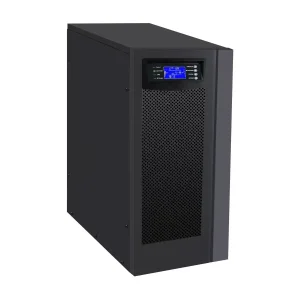
Paired with automatic transfer switchgear and high-power UPS frameworks, LC1D contactors switch auxiliary cooling circuits, secondary generator loops, and battery banks. Low contact resistance ensures minimal insertion loss and keeps thermal rise inside server rooms to a minimum.
Agricultural Irrigation & Deep Well Pumps
Pump stations in rural and agricultural regions face lightning transients and unstable single-phasing conditions. When coupled with our thermal overload relays and electronic surge arresters, LC1D setups help safeguard pumps against winding burnout.
Chinese Factory Ecosystem: Resilience, Quality & Scale
Headquartered in Yueqing, Zhejiang—the global capital of low-voltage electrical apparatus—our production facilities combine lean production lines with strong localized raw-material supply networks.
End-to-End Vertical Integration
From precision progressive stamping of copper conductors and automated injection molding of thermoset DMC/BMC housings to automated multi-spindle coil winding, we manage over 85% of our component value stream in-house. This limits supply-chain bottlenecks and preserves dimensional tolerances down to ±0.02 mm.
Automated Optical & Electrical Testing (AOI)
Every assembled contactor passes through an automated testing carousel that evaluates contact stroke, wipe, pick-up voltage (Vpo), drop-out voltage (Vdo), coil resistance, and dielectric withstand (2500V AC). Units with borderline travel profiles are rejected automatically, eliminating human testing error.
Cost Stability & Raw Material Hedging
With strategic reserves and proactive hedging for critical commodities like electrolytic copper, fine silver, and silicon steel, we shield global OEM distributors from erratic spot-market fluctuations, ensuring predictable, competitive wholesale pricing year-round.
Technology Roadmap: The Smart Contactor Transformation
Electromechanical switching continues to evolve. Our R&D center is leading three primary transitions in contactor design, pairing digital intelligence with proven mechanical reliability:
Hybrid Solid-State Zero-Crossing Switching
By putting anti-parallel thyristors (SCRs) in parallel with mechanical contacts, current is made and broken precisely at current zero-crossing. The mechanical contacts then carry the continuous load. This setup virtually eliminates arc erosion and can extend contact life past 10 million cycles under AC-3 conditions.
Edge Predictive Diagnostics & Bus Integration
Next-generation auxiliary heads incorporate micro-Hall-effect sensors, thermal probes, and IO-Link / Modbus-RTU transceivers. These sense contact wear, bounce frequency, and thermal rise in real time, alerting supervisory SCADA architectures before unplanned downtime occurs.
Eco-Friendly Engineering Materials
We continue moving beyond legacy plastics toward halogen-free, bio-based polyamide compounds with UL94-V0 flame retardancy ratings, complying with tightening RoHS and REACH regulations and lowering embodied carbon across global distribution networks.
Global Compliance & Engineering Assurance
Entering international switchgear, industrial refrigeration, and infrastructure markets requires comprehensive international compliance. We support our OEM partners with full documentation, certification, and responsive technical services.
Global Certification Standards
Every model in our line complies with IEC/EN 60947-4-1, IEC/EN 60947-5-1, GB/T 14048.4, and CE Low Voltage Directive requirements. We also provide test reports and documentation for UL 508 / CSA C22.2 No. 14 industrial control equipment evaluations.
Flexible OEM & ODM Customization
We offer private laser labeling, custom corporate enclosure colorways, non-standard coil operating voltages (such as 24V, 42V, 48V, 110V, 380V, 415V, and 440V AC/DC), and varied terminal arrangements (screw clamp, ring lug, fast-on) tailored to your assembly processes.
Lifecycle Support & Field Assurance
Backing every shipment is an extensive parts inventory, digital trace documentation for subcomponents, detailed engineering datasheets, 3D STEP models for e-CAD design, and multi-lingual technical engineering assistance.
Technical FAQ: LC1D AC Contactors
Key answers to common questions about selecting, rating, and integrating LC1D contactors in industrial control panels.
What is the difference between AC-1, AC-3, and AC-4 operational duty ratings?
Under IEC 60947-4-1, AC-1 applies to non-inductive or slightly inductive loads, such as resistance furnaces and heaters, where making and breaking currents equal normal running current (cos φ ≥ 0.95). AC-3 covers squirrel-cage induction motors, where the contactor withstands inrush currents around 5 to 7 times nominal current during starting and breaks nominal motor current at rated speed. AC-4 involves plugging, inching, and reverse jogging, requiring breaking peak locked-rotor currents during rotation, which necessitates intentional contact derating to maintain service life.
How does ambient altitude impact contactor performance?
At altitudes over 2,000 meters above sea level, lower air density reduces convective cooling and lowers atmospheric dielectric strength. In these environments, contactors require de-rating for operational voltage (Ue) and continuous current (Ie). For installations between 2,000m and 3,000m, apply a standard derating factor of 0.89 to operational current and 0.83 to maximum dielectric voltage, or select the next larger contactor frame size.
Why do contactors experience coil buzz or hum, and how do you prevent it?
Coil hum usually stems from split or broken copper shading rings on the pole face of an AC magnetic core, excessive dust or oil film between the armature and core faces preventing full seated closure, or low line voltage below the required pickup threshold (typically ≥ 85% Us). Using electronic wide-band coils (AC/DC) helps prevent this issue, as electronic drive circuitry maintains smooth, chatter-free DC holding current without mechanical shading rings.
Can DC control voltages drive standard AC LC1D contactors?
Standard AC coils cannot run on DC power because an AC coil relies on inductive reactance (impedance) to limit operating current. Supplying DC directly will cause excessive current and burn out an AC coil within minutes. For DC control setups, specify dedicated DC coil variants (e.g., LC1D--BD for 24V DC, LC1D--ED for 48V DC), which incorporate higher internal resistance and appropriate coil turns.
What is the standard procedure to identify worn contacts?
Inspect contact points during scheduled maintenance: check for deep pitting, excessive material loss (>50% of the original silver tip thickness), or discoloration on the housing plastic from localized heating. Check contact resistance across all closed poles using a micro-ohmmeter; an increase exceeding 300% of baseline indicates it is time to replace the contact kit or swap out the entire unit.
What surge suppression modules should be used across contactor coils?
When de-energizing an electromagnetic coil, collapsing magnetic fields generate back-EMF spikes that can reach several kilovolts, potentially damaging nearby PLC outputs and microcontrollers. For AC coil circuits, choose an RC snubber network to clamp dv/dt rise. For DC coils, use a freewheeling flyback diode or bidirectional TVS diode to suppress voltage spikes below safe component thresholds.
Complete Electrical & Protection Solutions
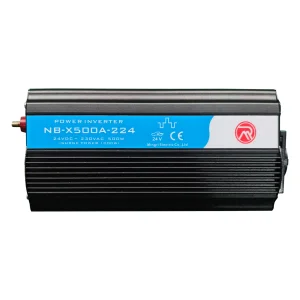
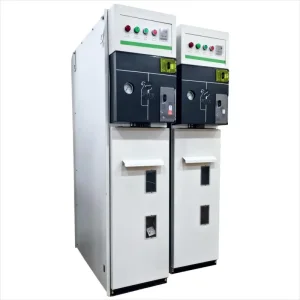
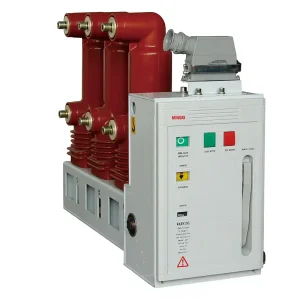
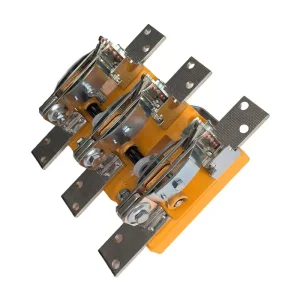
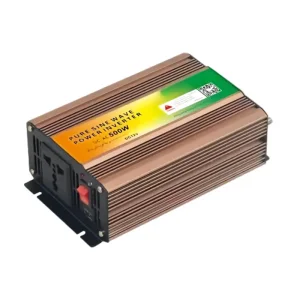
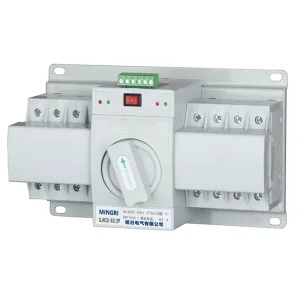
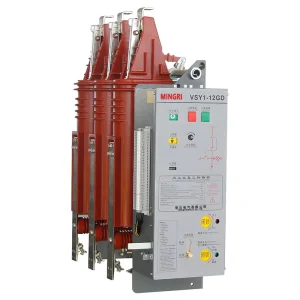
Complementing our LC1D contactor lines, explore our range of medium-voltage switchgear, pure sine wave power inverters, residual current breakers, and intelligent automatic transfer switches.