Choosing Substation Switchgear is not simply a matter of matching a voltage label to a catalog page. The equipment must suit the substation’s electrical conditions, operating environment, and maintenance resources. Start with the system voltage, rated current, and prospective fault current. Then consider insulation requirements, switching duty, protection interfaces, and the consequences of an outage. A 12 kV indoor feeder and an outdoor installation exposed to dust, moisture, or temperature swings may need very different designs. Small details matter.
A useful selection process also looks beyond purchase price. Compare the switchgear’s footprint, access for inspection, spare-parts availability, and options for future feeders. Ask manufacturers for technical data, test documentation, and clear explanations of service requirements. Check that proposed ratings and configurations align with the project specification and applicable standards; have qualified electrical professionals review the final choice. A spreadsheet helps, but it cannot capture every site condition. That is easy to forget. For example, a cabinet that fits neatly on a drawing may leave too little working space once cables and maintenance access are considered. The right decision balances safety, reliability, lifecycle cost, and practical operation. No single product is best for every substation. This guide outlines the questions that help teams compare options carefully—and recognize where more site-specific review is needed.
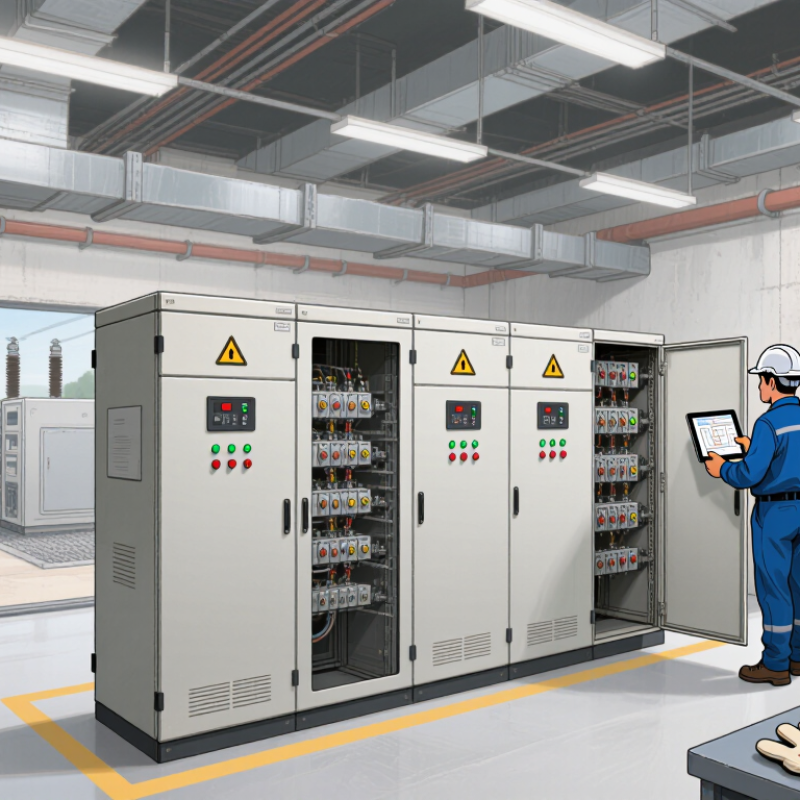
Understanding the Role of Switchgear in a Substation
In a substation, switchgear controls, protects, and isolates electrical circuits. It links incoming lines, transformers, busbars, and outgoing feeders. When a fault occurs, circuit breakers interrupt dangerous current; disconnectors create visible isolation for maintenance. The distinction matters. A disconnector is not designed to clear a fault, so protection settings and operating procedures must work together.
The International Energy Agency’s 2023 report, Electricity Grids and Secure Energy Transitions, says annual grid investment must rise above 600 billion US dollars by 2030 to meet global needs. That figure covers grids broadly, not switchgear alone, but it shows why dependable substations matter. For selection, engineers match rated voltage and current, short-circuit breaking capacity, insulation level, and site conditions. A coastal yard, for example, may need stronger corrosion protection than an indoor installation. Dust, heat, humidity, and access for maintenance also shape the choice.
The nameplate is only part of the story. Check how protection relays, interlocks, and control systems coordinate under real fault conditions. Ask how equipment will be inspected, tested, and safely isolated years later. Small details matter. A specification can look complete yet overlook cramped cable access or a difficult breaker replacement. That gap deserves a second look.
How to Choose the Right Substation Switchgear? - Understanding the Role of Switchgear in a Substation
| Selection dimension | Role in the substation | What to assess | Practical selection guidance |
|---|---|---|---|
| System voltage | Connects, carries, and isolates circuits at the substation’s operating voltage. | Nominal system voltage, highest system voltage, frequency, and insulation requirements. | Select equipment with rated voltage and insulation levels suitable for the system and applicable standards. Medium-voltage and high-voltage equipment are designed for different voltage classes. |
| Short-circuit duty | Allows circuit breakers to interrupt faults and enables the assembly to withstand fault currents. | Prospective fault current, clearing time, peak making current, and short-time withstand current from the system study. | Match breaker interrupting capacity and switchgear withstand ratings to the approved fault study. Do not choose ratings from normal load current alone. |
| Insulation and switchgear type | Insulates live parts and supports safe switching and isolation. | Air-insulated switchgear (AIS), gas-insulated switchgear (GIS), or other approved designs; site footprint and environmental conditions. | AIS is often suitable where space is available and straightforward access is valued. GIS can reduce the installation footprint, but gas handling, maintenance, and end-of-life requirements need consideration. |
| Load and circuit function | Manages incoming supplies, transformers, bus sections, feeders, and auxiliary circuits. | Continuous current, expected load growth, switching frequency, and the function of each bay or panel. | Size busbars and circuit components for the expected operating current and planned expansion. Specify circuit breakers, disconnectors, and earthing switches according to their distinct duties. |
| Protection and control | Detects abnormal conditions and initiates circuit interruption to limit equipment damage and maintain system stability. | Protection functions, instrument transformer interfaces, trip circuits, interlocking, alarms, and control-system communications. | Coordinate relay settings and breaker operating times with the protection study. Confirm that interlocks and remote-control interfaces meet the substation’s operating philosophy. |
| Safety and access | Supports safe operation, maintenance, and isolation of equipment. | Internal-arc classification where required, access restrictions, earthing provisions, interlocks, clearances, and maintenance procedures. | Review the site risk assessment and applicable safety requirements. Internal-arc performance is configuration- and installation-dependent; verify the tested arrangement and installation conditions. |
| Site and environmental conditions | Ensures reliable operation in the actual installation environment. | Indoor or outdoor installation, ambient temperature, altitude, humidity, pollution, corrosion, seismic conditions, and flooding risk. | Check equipment ratings and enclosure requirements against site conditions. Specify suitable protection against moisture, dust, salt, or corrosive atmospheres when relevant. |
| Maintenance and lifecycle | Maintains availability and helps control operating costs over the equipment’s service life. | Inspection intervals, spare-parts access, condition monitoring, outage windows, training, and end-of-life handling. | Compare lifecycle needs, not just purchase price. For gas-insulated equipment, include gas monitoring, leakage management, and applicable recovery and disposal procedures. |
| Standards and compliance | Provides a common basis for equipment ratings, testing, and safe application. | Project jurisdiction, utility specifications, and relevant IEC or IEEE/ANSI standards. | State the governing standards and editions in the procurement specification. Verify that ratings, type-test evidence, and documentation match the project requirements. |
Selection note: Final switchgear specifications should be based on the substation design, load-flow and fault studies, protection coordination, site conditions, and applicable regulations. Equipment ratings and configurations must be verified by qualified electrical engineers.
FAQS
It controls, protects, and isolates electrical circuits. It connects incoming lines, transformers, busbars, and outgoing feeders.
Circuit breakers interrupt fault current. Disconnectors provide visible isolation for maintenance; they are not designed to clear faults. The distinction matters.
Match voltage, current, breaking capacity, insulation level, and site conditions. Consider heat, dust, humidity, and corrosion. Small details count.
It can work well where space allows clearances and easy access. Visible parts help inspection, but salt spray and moisture may mean more cleaning.
It can reduce the equipment footprint, which helps at compact urban sites. Future access may be less straightforward. Space is tight.
It combines elements of air- and gas-insulated approaches. It may reduce layout size without enclosing every component. Not a perfect fit everywhere.
A single bus is simpler and often less costly, but maintenance may require an outage. Double-bus or breaker-and-a-half designs add flexibility and complexity.
Check cable routes, drainage, lifting access, ambient temperature, and breaker replacement space. Ask crews about switching frequency and realistic outage windows. Paper plans can mislead.
They must coordinate under real fault conditions. Confirm inspection, testing, and safe isolation procedures. A complete-looking specification can still miss cramped cable access.
Conclusion
Choosing the right Substation Switchgear begins with understanding its role in controlling, protecting, and isolating electrical circuits throughout a substation. Start by defining the system’s voltage, current, fault-interruption, and operating requirements, as well as how the equipment will be used under normal and abnormal conditions. These details help narrow the choice to suitable switchgear types and configurations, including options designed for different layouts and levels of accessibility.
Next, consider the installation environment, available space, climate, safety provisions, and the maintenance resources needed over the equipment’s service life. Compare how easily each option can be inspected, operated, and serviced, while accounting for reliability and future expansion. Before making a final selection, verify that the proposed equipment meets applicable technical and safety requirements and fits the substation’s operating plans. A systematic assessment helps ensure the chosen switchgear is practical, safe, and appropriate for the site.
